Every new year it’s the same thing. I make a promise to myself to write more for my website and then within a couple of weeks it’s all got to pot. This is my first post and it’s February for goodness sake. There is one of two lessons to learn here then – either try harder, or don’t bother making resolutions. I’ll let you guess on which end of this particular see-saw I am currently sitting.
But surely trying to do better is the key thing, even if one completely fails to progress beyond the thought of trying to do better? Well, apparently not. It turns out that actually doing better is the key thing, although there are many things that can hinder our efforts.
At the end of last year I headed over to Atlanta in Georgia for two main reasons, both of which (helpfully for this blog post) focused on high performance. I’d never been to Atlanta before, and I’d recommend it. It was a really friendly place and it has a magnificent aquarium. Seriously, it’s a really good aquarium.

Anyway, fish-aside, my first port of call was the National Institute for Student Success which runs out of Georgia State University. Their mission is to help universities identify and resolve institutional barriers to completion and was formed to support students in their transition to HE and then to succeed, and now it works with other universities to help them to do the same. They do this through a number of different schemes, but the main ones are a set of signature programmes which focus on pre-enrolment, community building, and semester 1 support. They also make excellent use of student data, particularly longitudinal datasets, and positive comms to deploy proactive interventions to keep their students ‘on path’. Part of their approach, which I really liked, was to ask the difficult questions of universities – such as, “what is our complicity in drop-out rates?” Essentially, to what extent are we the problem?
There is an excellent book, Won’t lose this Dream, which explores the work of GSU and the NISS in more detail, and gives more information on their history and development.
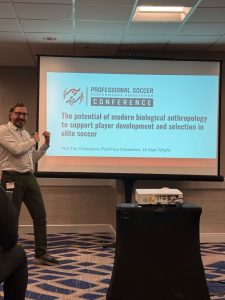
The other reason for heading to the Peach State was to present at the Professional Soccer Performance Association conference. Here I gave a paper which expanded a bit on our recent publication in Football Studies where we detail to anyone who will listen that the application of biological anthropological methods, approaches and data may help in talent identification and player development.
Although the focus of the conference was on soccer, this was a conference about high performance. What is it, what does it mean to do it, and what does it look like when you’ve done it. Many of the other presentations focused on the use of data for effective interventions and thus the discussions were similar to the ones I’ve heard in HE. For example, identifying new data sources which allow you to measure what is really going on, ensuring that we are measuring the right thing to help us in our work, emphasising a holistic approach to data use, getting the right people in the right places, and determining the return on investment of any intervention applied. The key difference was that the presenters were much much fitter than the average academic.
All of this suggests an interesting and fundamental question to think about – what does high performance mean, and is it something that we all can or should achieve? If you listen to the Parenting Hell podcast, they recently argued that this constant striving for incremental betterment and marginal gains was all a bit much, and maybe we should be looking to low performance and with that, general contentment. If they have a point, it doesn’t sit well with this post, so we won’t dwell on it, but we will pick up on a couple of aspects of what they imply in their discussion. First, that high performance is clearly context specific. Can I become a high performing football player? No, clearly not (although at the moment, I’d probably have a decent shout at the West Ham squad). Can I become a high performing armchair critic? Absolutely, and I’m already an accomplished amateur.
Second, that high performance is a team sport. One of the other things that I find interesting about this work in soccer is that achieving high performance requires a multidisciplinary team who (ideally) are high performing in their own areas. In fact Gareth Southgate says the same in his new book Dear England: Lessons in Leadership – “High performance teams need high-performance staff. Indeed, you can’t aspire to be the former without installing the latter. And that’s in every department, without exception”.
As I hope it is clear by now, there are blindingly obvious parallels between high performance in sport and our work in higher education to help our students and staff improve. Things that are needed in both spheres are:
> A clear definition of what success is
> A subsequent clear definition of what high performing looks like in terms of achieving that success
> A talented multidisciplinary team that wraps around that person to help them achieve that definition
> Constant feedback, reflection and action
> Use of a variety of data to help understand where a person is, what is impacting their progress, and how to measure progress
> Recognising the setbacks will happen, because it’s a process not a destination
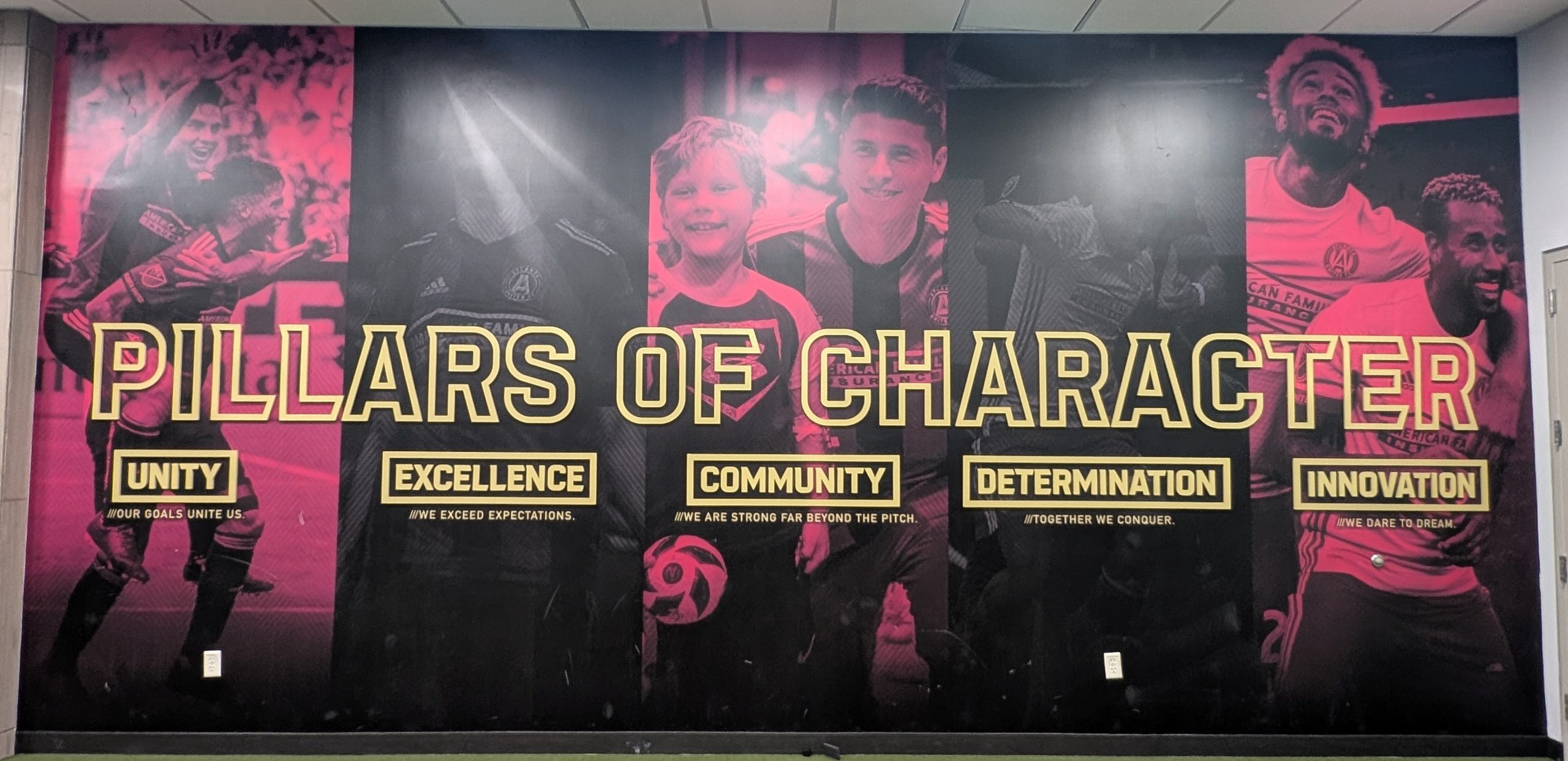
And in both contexts of work, some of this is also about removing the obstacles to high performance – something that the NISS doubled down on when I was with them and something which is at the heart of our fantastic new Global Changemakers Programme which is a funded short-term international mobility experience designed for students who might not be able to take part in semester or year-long study abroad due to circumstances that are outside of their control.
One speaker at the PSPA conference, Paul Balsom, stated that in soccer, the “demands of the game are increasing, but it’s still all about people”. You could (and should) say exactly the same about higher ed.
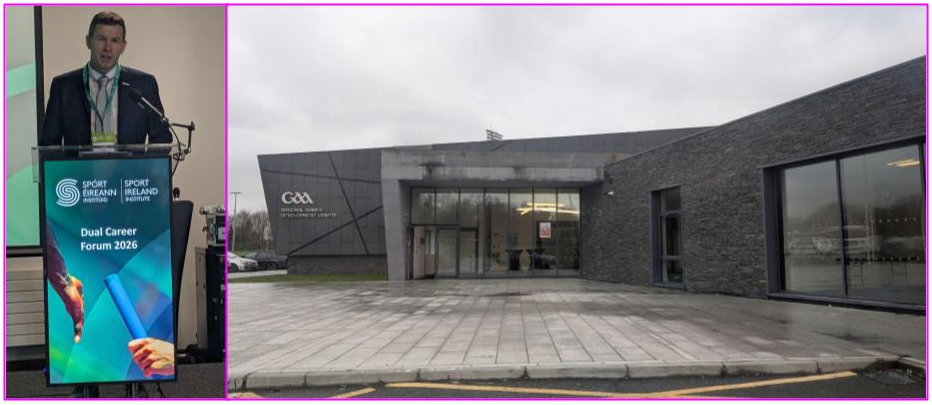
I write all of this on the day that we received our Accreditation for Student Athlete Support award from Spórt Éireann / Sport Ireland. This is a recognition of a university’s commitment to supporting dual career students, largely by putting in place structures and supports that allow for a successful sporting career while simultaneously allowing for a successful academic career. We take a whole-university approach to this, recognising that having a successful dual career touches on all aspects of the student journal and experience. I’m always incredibly impressed by our young athletes because juggling high performance in sport and high performance in study is extremely challenging – so the least we can do is remove some of our internal blockages to their success.